Snapshot No. 855-859
The same photo as the last, but with a bit wider angle.
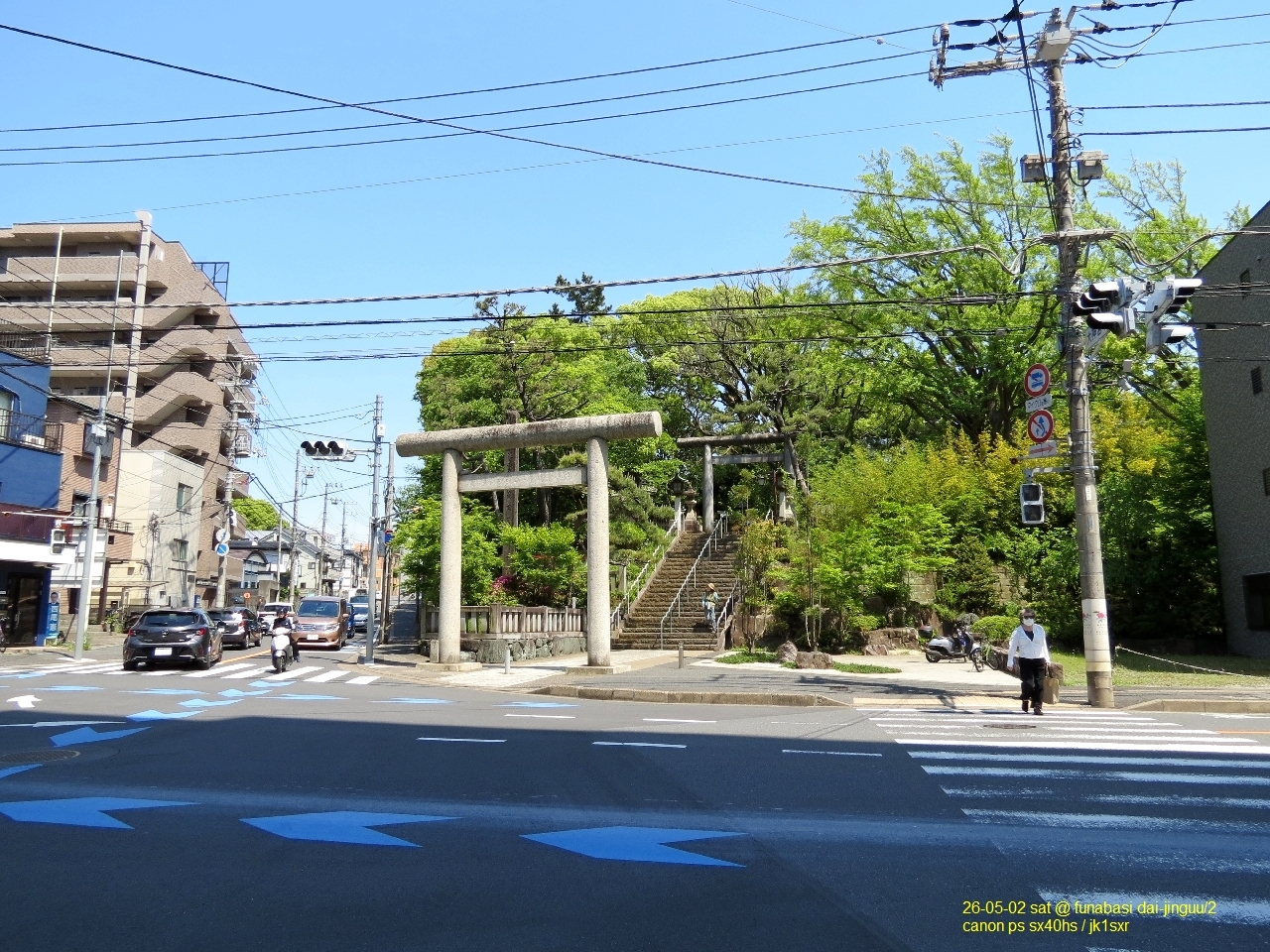 Despite the shrine front, many utility poles with power/comm. cables criss-crossing.
Shameful indeed.
The very evidence of developing country.
Above all, an act of inviting divine retribution.
Anyway, this time, the story is about the relationship of this place with the author of the well konwn "Sarasina Diary" of Heian period.
It begins just about 1,000 years ago, when the author was a girl of 12 years old, who was badly wanting to read "stories" like The Tale of Genji, which books are supposed to be available in Kyoto.
Her much awaited time finall came, upon her father's end of the term as a high-ranking official of Kazusa Province.
Her family started to leave their home for Kyoto in the Kannin 4th year (1020 CE) 9th month (lunar calendar).
It says that after entering Simoosa Province from Kazusa, they stayed overnight at "Kuroto shore" by making a temporary shed. Today there is no place called "Kuroto" in the area, and there have been many debates about the exact location.
Whether professional or amateur, there are many opinions. Majority suggest the place around the front of this shrine, considering the author's dipiction of the surroundings, the locations of stay the days before and after, and an interpretation of old wordings ("kuro" = area a bit hgher than the surrounding, "to" = port, thus "Kuroto shore" means a shore of port with high area behind).
What I wonder is that none talks with the view point of the material procurement, etc. for the dozens of people travelling, families on carts, necessities on horsebacks (even with temporary shed materials).
This is not the story of the Edo period, when people could travel to Kyouto empty-handed, by following the post towns.
With this view point, the staying place can not be selected on a whim. If there is a place, which can safely accomodate many people, and is convenient for supply of foods and others, cart maintenace, horse rest, etc., they naturally choose such place. So the front area of this shrine, even if much smaller at the time, where local folks gather from time to time, with a port alongside, must have been a logical choice for the group.
The reason for the shrine's front had been a beach is that the area's sea is naturally shallow up to a distant place, and the Heian period was in a severe climate warming time, and sea level was much higher than today.
At present, Funabasi's southernmost place, Sapporo Beer Factory facing the sea is 3.6 km away from here. Though it sounds like a lie, in the old days, beyond the shrine, the sea had stretched out.
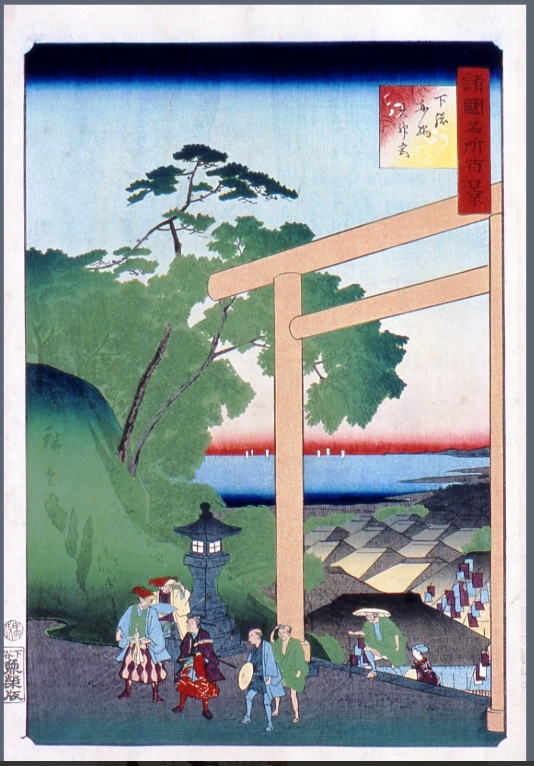 The left is an ukiyoe borrowed from the Ken Museum site.
The artist is Utagawa Hirosige II at the end of Edo period.
This reveals that even at this late time, only several houses existed in front of the Torii, and behind there, the shallow sea stretched.
Tiba Central Museum / Collection of artworks (pictures) / One hundred famous views in the provinces / Funabasi Grand Shrine in Simoosa
Even today, the elevation of Tiba highway / Route 14 just south of JR Funabasi station is 2m only.
Though astonishingly low, there are many such places in the cities close to the sea (the elevation of Tokyo / Yurakuchou Station area is also 2m.)
Sarasina Diary#1
Wiki in English is here .
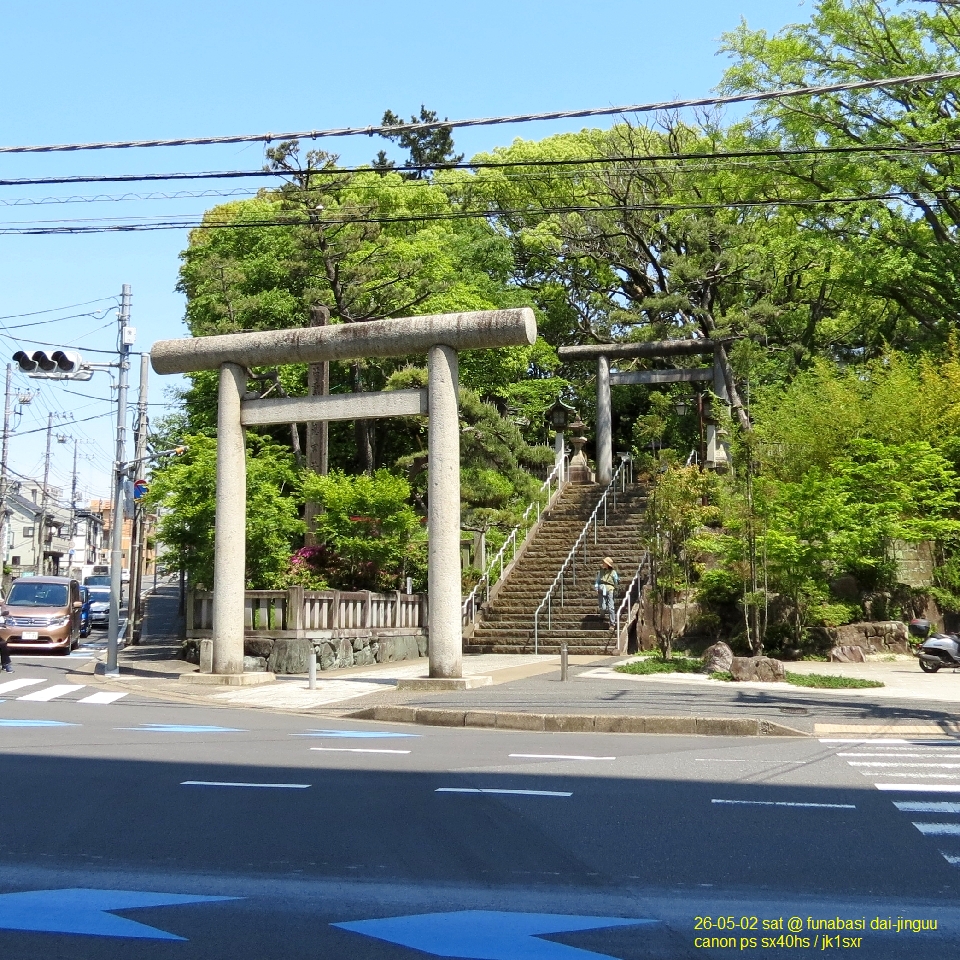 Pleasant weather brought us to wander through Funabasi streets. Shots of yesterday.
Whne it comes to Funabasi, we think of the Grand Shrine.
Behind the front tori-i stands 8 m or so tall stone pillar. I wonder how it was made, at least it can not be a monolith.
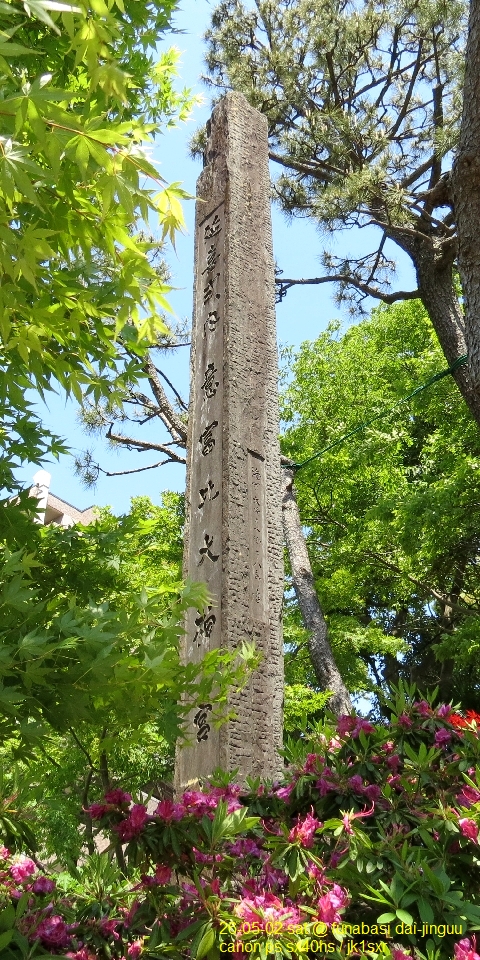
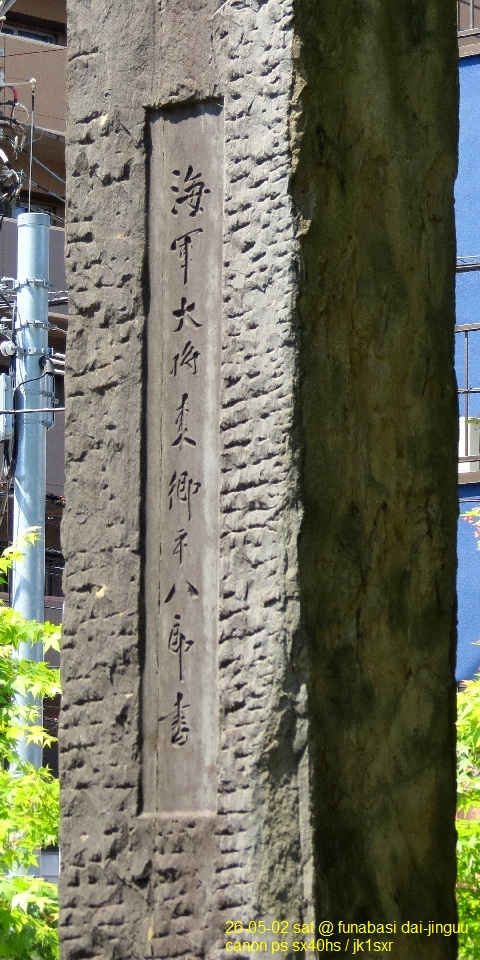 Front face reads; "Engi-shiki Oohi Grand Shrine".
"Oohi Shrine" is the formal name. I did not know that.
Side face reads; "caligraphy by Navy Admimal Tougou Heihachirou". Wow!
I feel the "Admiral Tougou" is much more well known, in Northern-, Eastern-Europe and Middle East, i.e., countries facing direct Russian threats, than in here.
Since early 70s, I had worked together with Swedes for my work. It was a customary I was asked by new visitors from Sweden, "Where the battleship "Mikasa" is moored? Thanks to them, I got to know more about such matters.
Today "arms exports" are being discussed. I can undertstand negative sentiment against them. However, at the same time, it will be certainly worthwhile, before making any decision, to rexamine the case, if by any chance, the then the UK government had not allowed Vickers to export the battleship to Japan, then, what alternatives had remained for the people of three generations ago, and ensuing possible consequences, etc.
Raining today, from morning.
Below are shots taken two weeks ago, at Tukuba college town.
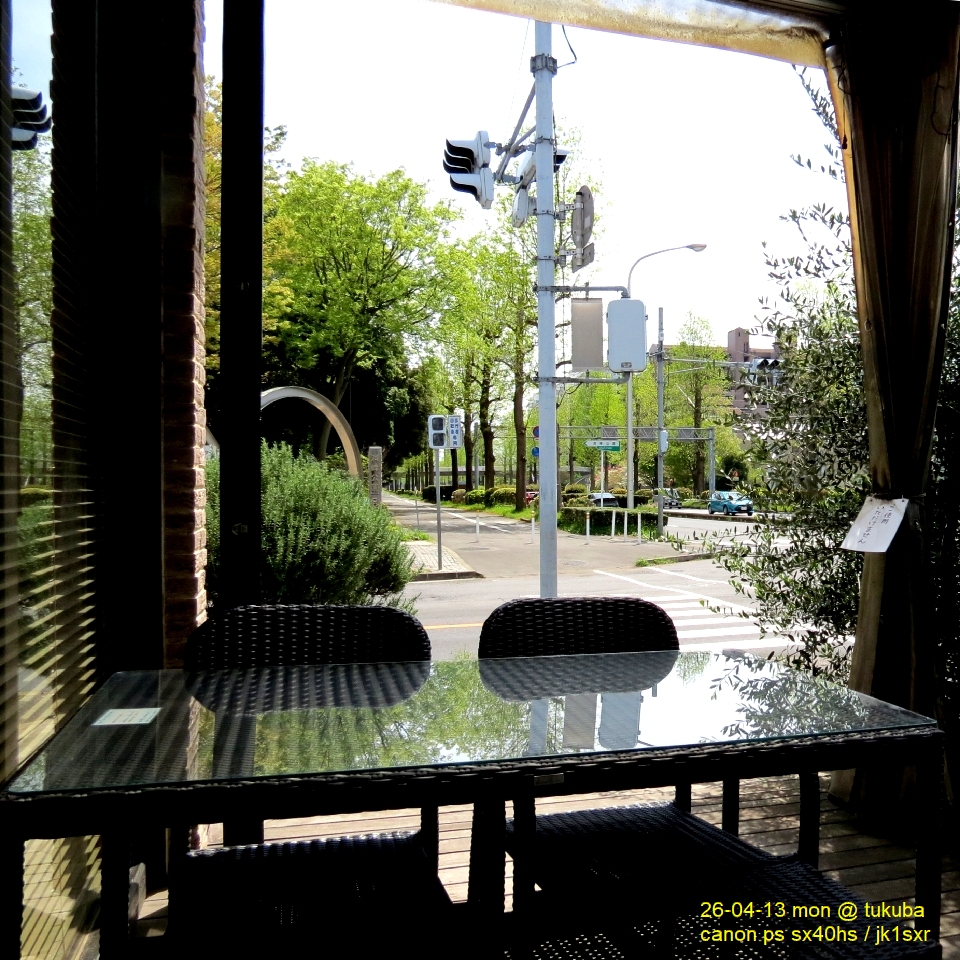 A short break at our favorite shop, facing Douhou Square street, after an hour or so drive.
My favorite, tulip trees along the street growing as high as they wish were spledind at this time of year. But now, their tops were all cut down. Regrettable indeed!
In the area, just ahead, around Meteorological Research Institute, about a half were replaced with the young tulip trees.
Upon crossing the street in the photo, I encounterd a Jizou san, whom I do not remember.
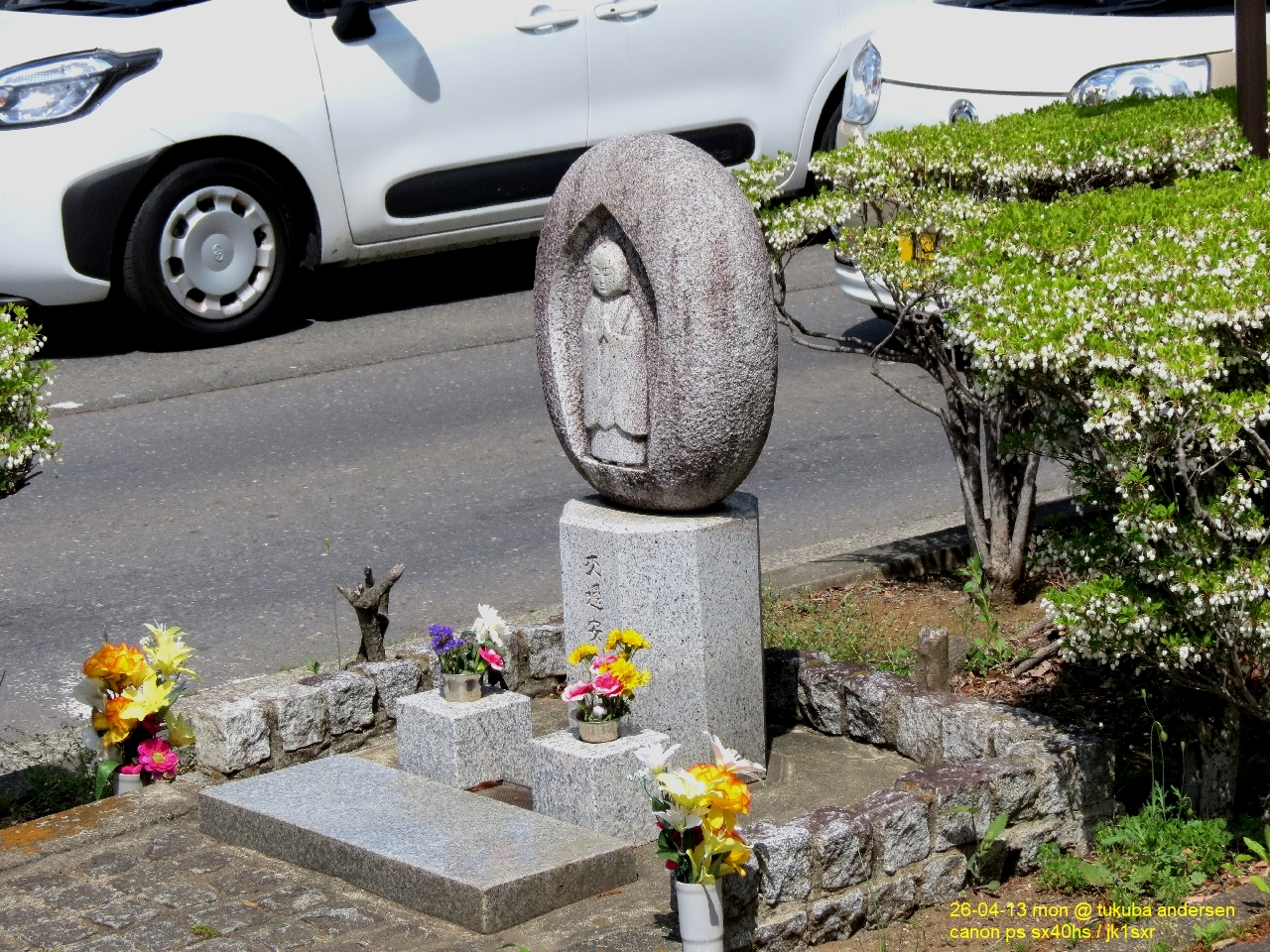 To see a Jizou san placed alone at a roadside is poignant. And even more so, if it is new.
It is probably because we sense both a past misfortune occurred here, and a wish of the person saddened by it that no other people suffer such a fate.
And the authorities too must have shared the same wish, and allowed to allocate this roadside space.
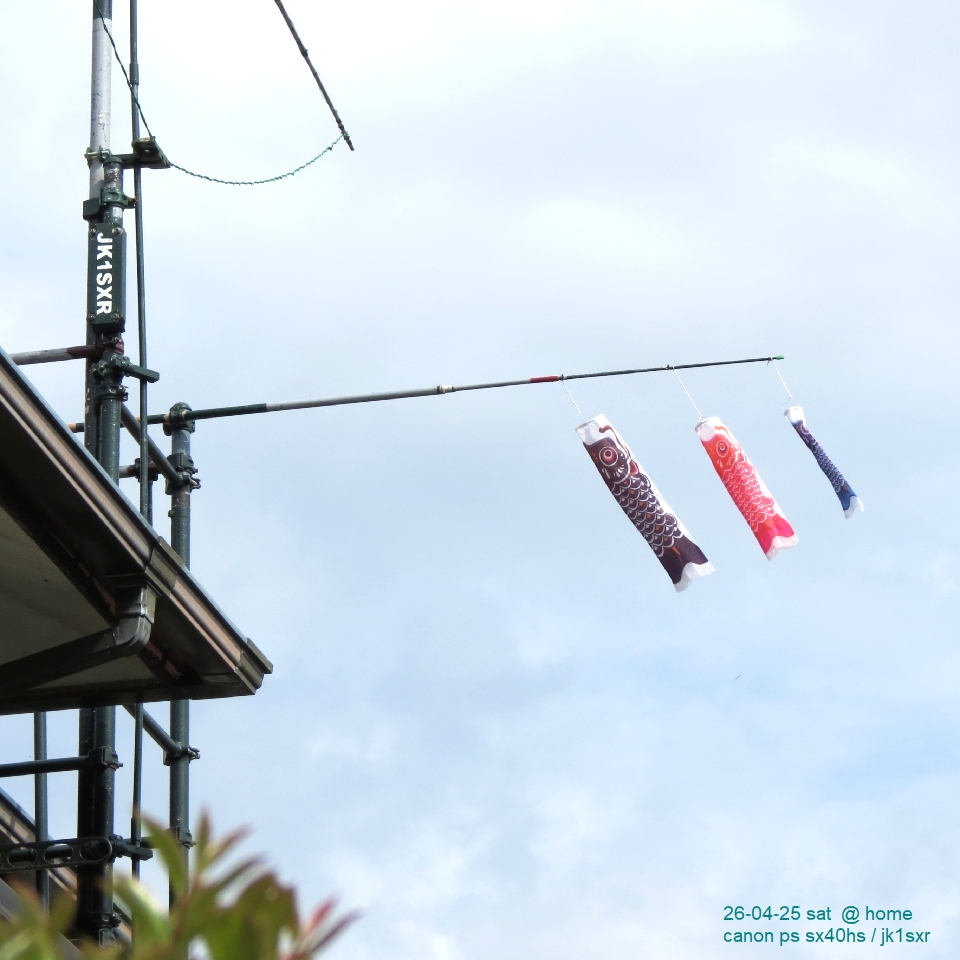 The weather is getting pleasant.
It's your turn! toy koi-nobori.
- - -
Kawayui!!
Koi-nobori#1
Carp-shaped streamer displayed around May 5th / Children's Day (national holiday), wishing for healthy growth of children.
Flowers blooming at this time of year, even if special care is not applied at all.
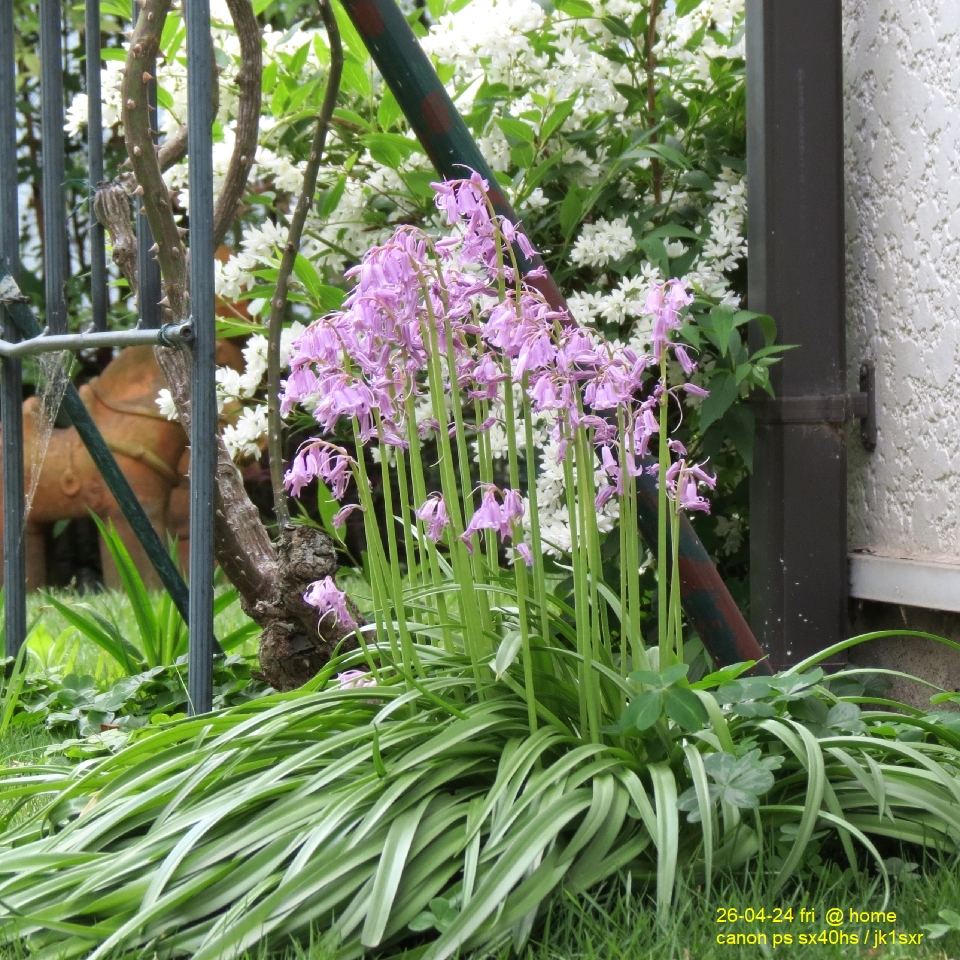 Turigane suisen (literally means [large size suspending bell at temple] + [narcissus]), Spanish Blue Bell?
After flowering, both flowers and leaves rapidly wither and completley get buried under turf. So I forget about even that existence. Yet, ever year, it comes out in spring.
The reason for its too many leaves must be to achieve the photosynthesis within 3 months or so, insted of the usual half a year.
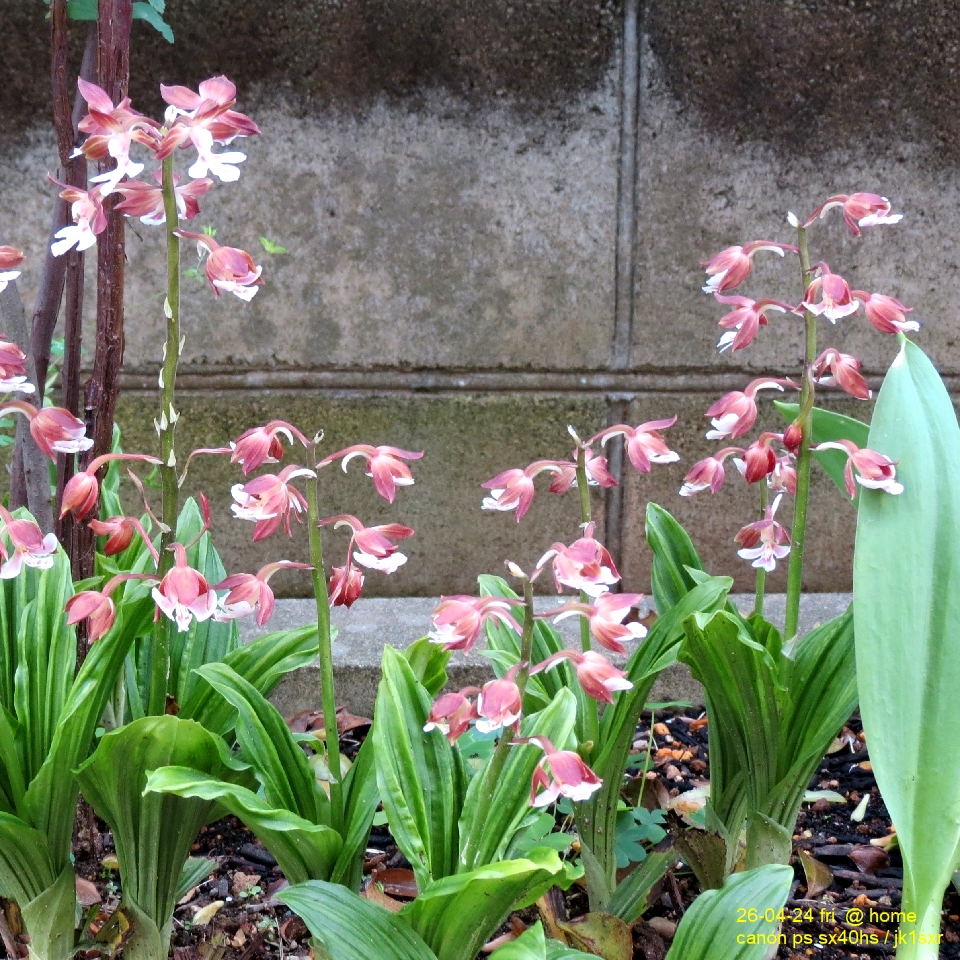 Ebine (literally means [lobster-like roots])
Forest development and illegal foraging are decreasing this natural population.
Checking the red data shows ebine being NT (Near Threatened) at this area of Tiba, Tokyo. While Saitama, Nagano, etc. designate even severer VU II (VUlnerable II).
26/R8-05-03 sun
859. Funabasi Shrine and Sarasina Diary#1The same photo as the last, but with a bit wider angle.
Despite the shrine front, many utility poles with power/comm. cables criss-crossing.Shameful indeed.
The very evidence of developing country.
Above all, an act of inviting divine retribution.
Anyway, this time, the story is about the relationship of this place with the author of the well konwn "Sarasina Diary" of Heian period.
It begins just about 1,000 years ago, when the author was a girl of 12 years old, who was badly wanting to read "stories" like The Tale of Genji, which books are supposed to be available in Kyoto.
Her much awaited time finall came, upon her father's end of the term as a high-ranking official of Kazusa Province.
Her family started to leave their home for Kyoto in the Kannin 4th year (1020 CE) 9th month (lunar calendar).
It says that after entering Simoosa Province from Kazusa, they stayed overnight at "Kuroto shore" by making a temporary shed. Today there is no place called "Kuroto" in the area, and there have been many debates about the exact location.
Whether professional or amateur, there are many opinions. Majority suggest the place around the front of this shrine, considering the author's dipiction of the surroundings, the locations of stay the days before and after, and an interpretation of old wordings ("kuro" = area a bit hgher than the surrounding, "to" = port, thus "Kuroto shore" means a shore of port with high area behind).
What I wonder is that none talks with the view point of the material procurement, etc. for the dozens of people travelling, families on carts, necessities on horsebacks (even with temporary shed materials).
This is not the story of the Edo period, when people could travel to Kyouto empty-handed, by following the post towns.
With this view point, the staying place can not be selected on a whim. If there is a place, which can safely accomodate many people, and is convenient for supply of foods and others, cart maintenace, horse rest, etc., they naturally choose such place. So the front area of this shrine, even if much smaller at the time, where local folks gather from time to time, with a port alongside, must have been a logical choice for the group.
The reason for the shrine's front had been a beach is that the area's sea is naturally shallow up to a distant place, and the Heian period was in a severe climate warming time, and sea level was much higher than today.
At present, Funabasi's southernmost place, Sapporo Beer Factory facing the sea is 3.6 km away from here. Though it sounds like a lie, in the old days, beyond the shrine, the sea had stretched out.
The left is an ukiyoe borrowed from the Ken Museum site.The artist is Utagawa Hirosige II at the end of Edo period.
This reveals that even at this late time, only several houses existed in front of the Torii, and behind there, the shallow sea stretched.
Tiba Central Museum / Collection of artworks (pictures) / One hundred famous views in the provinces / Funabasi Grand Shrine in Simoosa
Even today, the elevation of Tiba highway / Route 14 just south of JR Funabasi station is 2m only.
Though astonishingly low, there are many such places in the cities close to the sea (the elevation of Tokyo / Yurakuchou Station area is also 2m.)
Sarasina Diary#1
Wiki in English is here .
26/R8-05-03 sun
858. Funabasi Grand Shrine
Pleasant weather brought us to wander through Funabasi streets. Shots of yesterday.Whne it comes to Funabasi, we think of the Grand Shrine.
Behind the front tori-i stands 8 m or so tall stone pillar. I wonder how it was made, at least it can not be a monolith.
Front face reads; "Engi-shiki Oohi Grand Shrine"."Oohi Shrine" is the formal name. I did not know that.
Side face reads; "caligraphy by Navy Admimal Tougou Heihachirou". Wow!
I feel the "Admiral Tougou" is much more well known, in Northern-, Eastern-Europe and Middle East, i.e., countries facing direct Russian threats, than in here.
Since early 70s, I had worked together with Swedes for my work. It was a customary I was asked by new visitors from Sweden, "Where the battleship "Mikasa" is moored? Thanks to them, I got to know more about such matters.
Today "arms exports" are being discussed. I can undertstand negative sentiment against them. However, at the same time, it will be certainly worthwhile, before making any decision, to rexamine the case, if by any chance, the then the UK government had not allowed Vickers to export the battleship to Japan, then, what alternatives had remained for the people of three generations ago, and ensuing possible consequences, etc.
26/R8-05-01 fri
857. A certain crossingRaining today, from morning.
Below are shots taken two weeks ago, at Tukuba college town.
A short break at our favorite shop, facing Douhou Square street, after an hour or so drive.My favorite, tulip trees along the street growing as high as they wish were spledind at this time of year. But now, their tops were all cut down. Regrettable indeed!
In the area, just ahead, around Meteorological Research Institute, about a half were replaced with the young tulip trees.
Upon crossing the street in the photo, I encounterd a Jizou san, whom I do not remember.
To see a Jizou san placed alone at a roadside is poignant. And even more so, if it is new.It is probably because we sense both a past misfortune occurred here, and a wish of the person saddened by it that no other people suffer such a fate.
And the authorities too must have shared the same wish, and allowed to allocate this roadside space.
26/R8-04-25 sat
856. Koi-nobori#1 season
The weather is getting pleasant.It's your turn! toy koi-nobori.
- - -
Kawayui!!
Koi-nobori#1
Carp-shaped streamer displayed around May 5th / Children's Day (national holiday), wishing for healthy growth of children.
26/R8-04-24 fri
855. Wild flowersFlowers blooming at this time of year, even if special care is not applied at all.
Turigane suisen (literally means [large size suspending bell at temple] + [narcissus]), Spanish Blue Bell?After flowering, both flowers and leaves rapidly wither and completley get buried under turf. So I forget about even that existence. Yet, ever year, it comes out in spring.
The reason for its too many leaves must be to achieve the photosynthesis within 3 months or so, insted of the usual half a year.
Ebine (literally means [lobster-like roots])Forest development and illegal foraging are decreasing this natural population.
Checking the red data shows ebine being NT (Near Threatened) at this area of Tiba, Tokyo. While Saitama, Nagano, etc. designate even severer VU II (VUlnerable II).
Copyright © 2013 JK1SXR/m.abe. All Rights subject to common sense.